Just read an article in "Ancient Egypt" magazine that there is a new controversy over Amenhotep III and his co-regency with his son Amenhotep IV (Ahkenaten). It seems that IF they were CO-regents (ruled together) for 9 years then daddy would have had a part in the heresy of the Aten cult and even helped in the building and moving the capital to Amarna. The heresy was a belief in only ONE god as opposed to ALL the gods of Egypt. Ahkenaten was branded a heretic and his name was scratched off every building and all his statues broken, the city of Amarna was leveled and the stone used elsewhere. Probably second only to Ramses the Great, Ancient Egypt's wealthiest and most powerful pharaoh was Amenhotep III. You've seen the gold of King Tut (a minor king) can you imagine what was in the tomb of his grandfather! All that wealth was spent on the Amarna period, along with the good will of the priests ... so ended the 18th Dynasty.
 |
| Amenhotep III |
 |
| Amenhotep IV (Ahkenaten) |
I challenge you to try out this Ancient Egyptian Pose (mudras). Remember the Right Arm is always raised unless it covers the heart. This is an impossible pose for a human but that was not the purpose of the relief (found in the temple in Esna). This is a pose of a dancer (leg crossed) in jubilation (right arm lifted) giving an offering (left arm extended)
Before David Roberts from England there was Giovannit Battista Belzoni from Venice. The "Great" Belzoni was a prolific Italian explorer and pioneer in Egyptian archaeology. He came to Egypt to show Muhammad Ali a hydraulic machine for irrigation in 1815. But he became famous for his paintings and written accounts of his travels throughout Egypt. I found a first edition copy of his prints and writings at a local Bauman's Rare Books and together they were selling for $25,000! So if anyone wants to get me a Birthday gift ...
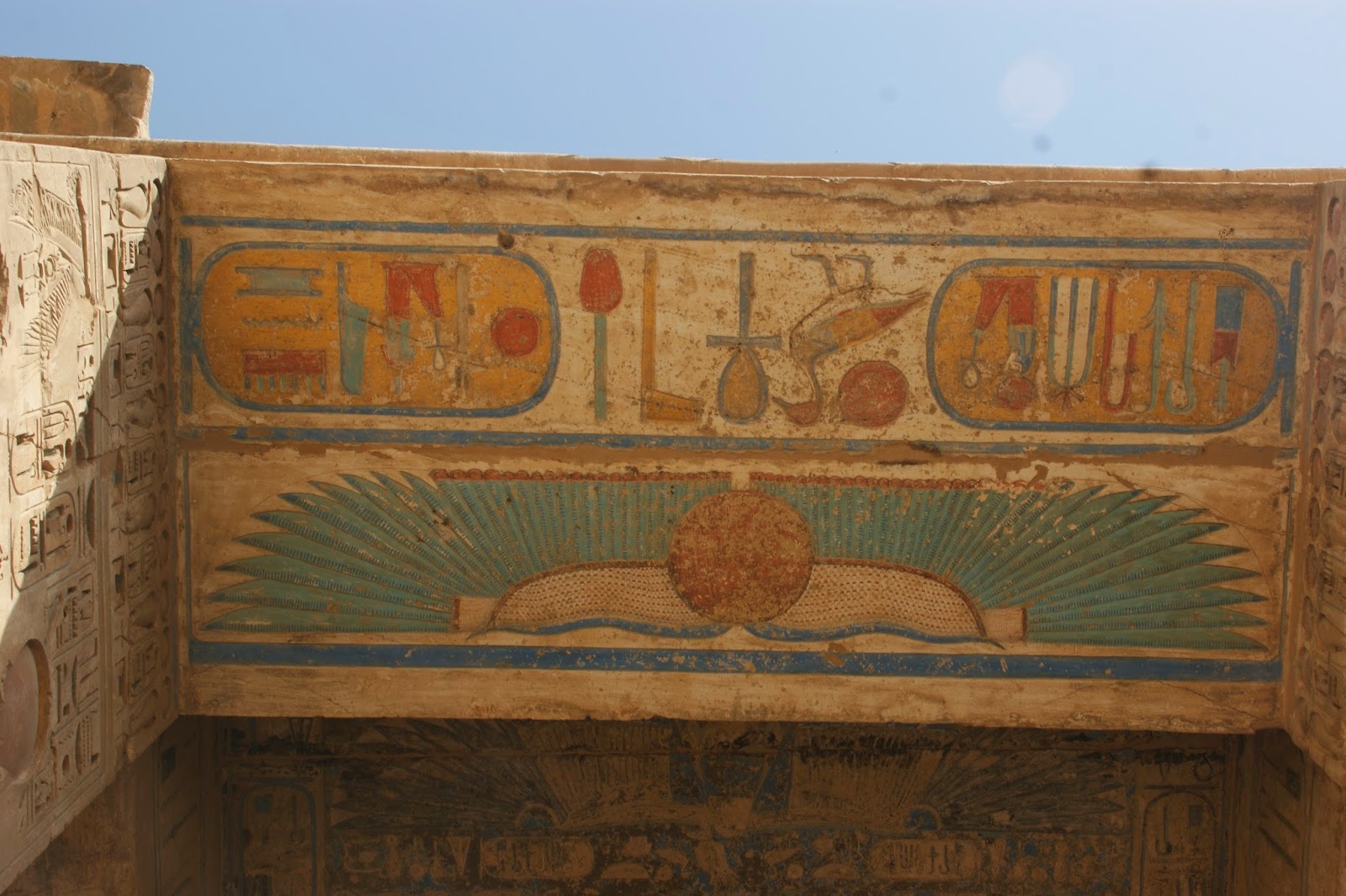
The temple of Ramses III at Madinet Habu is my favorite temple. One of the reasons is that it has some of the best colors of any temple. You can really start to see what the place looked like in its glory days.
Time to Tour Egypt with Me!
Did you know that if you stand on the mound where the buses drop you off in Dashur (Cairo area) you can count over 70 pyramids on the horizon surrounding you? We tend to think that there are only the 3 GREAT pyramids of Giza but there are SO many more. Especially if you count the pyramids of the wives that surround their King/husband. So much to see in Egypt that you can never get it in just one trip.
Time to Tour Egypt with Me! October 2014 trip filling fast!
In Ancient Egypt there was so much gold that it was not worth as much as you might think. Especially in the 18th and 19th Dynasties it was so plentiful that it covered most objects in temples and palaces. But silver was VERY hard to come by. Most of it had to be imported from the Levant. So if you saw King Tut's gold, especially his gold sarcophagus, you imagine the wealth of the time.
But image a solid silver sarcophagus! Right next to the King Tut display in the Cairo museum, where few people go is a room that has two silver sarcophagi. They are worth (In Ancient Egypt terms) TEN TIMES more than the King Tut gold ones.
Time to Tour Egypt With Me and see these!
Ahkenaten was the "heretic" pharaoh who picked up the capital city and moved it to Amarna (Ahkentaten) in the 18th Dynasty. His builders were the first to use "talatat" blocks. These were stones cut in a standard size (as opposed to fitted together like a puzzle done previously). He did this to build his city and temples to Aten quickly. They were thought to have been destroyed along with all that had anything to do with the heretical Amarna period. But then a wall at Karnak was opened and archaeologists found talatat blocks used inside the walls in Karnak as support. Probably stolen in the 19th Dynasty to build walls in Karnak they had to float them on barges hundreds of miles SOUTH or UP river to get them to Karnak.


.jpg)